Kernel · The future-of-work programme for people who run organisations
AI is rewriting how work runs. The people who run organisations should write what comes next.
Kernel is a four-week live programme for directors and executives. Thirty seats per cohort. Three questions. One report at the end of the year — the Human OS Index — written with every leader who took part and submitted to the institutions shaping the future of work.
Registration opens for the next cohort soon
Edition 2027 · Founding cohort forming
01 — The questions
Three questions every leader is asking. None of them has a vendor's answer.
Kernel is built around the three questions we hear from every director, in every sector. Each gets a live session, a working exercise and a document you keep.
Which parts of your business will AI actually change in the next eighteen months, and which parts are noise you're being sold? Move too late and you lose ground. Move too early on the wrong thing and you lose budget and credibility.
You leave with: your AI Exposure Map.
If AI absorbs a third of the work, what does the org chart look like? What is a manager for? What happens to the middle layer? Nobody wants to redesign an organisation blind and be wrong in public.
You leave with: your Org Redesign Blueprint.
When AI takes the tasks, what remains is judgement, persuasion, conflict, ambiguity and decisions under uncertainty. Can your managers actually do that, and how would you know?
You leave with: your Human Capability Readout, measured live on you.
Session 04 · Synthesis & peer clinic · Your questions, chosen by the cohort
02 — The format
Four weeks. Ninety minutes a week. Everything in between is yours to use.
- WEEK 00The cohort opens. Meet your 29 peers. Complete your baseline questionnaire.
- WEEK 01Session 1 · How fast, and where first?
- WEEK 02Session 2 · What does your organisation become?
- WEEK 03Session 3 · Do your people have what's left? (live diagnostic)
- WEEK 04Session 4 · Synthesis & peer clinic
- +30 DAYSSubmit your 90-day plan. Become a Kernel Fellow.
Live, and in the room.
Every session is live with Joss on Livestorm. It runs in the browser, and recordings are hosted in the EU. Each session keeps twenty minutes open for the questions the cohort submits.
A private space for your cohort.
A roster of your peers, the programme timeline, discussion on every exercise, and a direct line to Joss. It opens a week before Session 1 and becomes your alumni archive afterwards.
Kompunik All-Access included.
Twelve months of the full Kompunik platform, covering 28 human capabilities, the diagnostic and every learning track. Between sessions, this is where the work happens.
See what is on Kompunik03 — What you leave with
Documents your executive committee will actually read.
Every session produces a working document built from your own inputs, not a slide deck of someone else's opinions. Download them, edit them, and take them into your next board meeting.
Kernel Fellow is earned, not handed out.
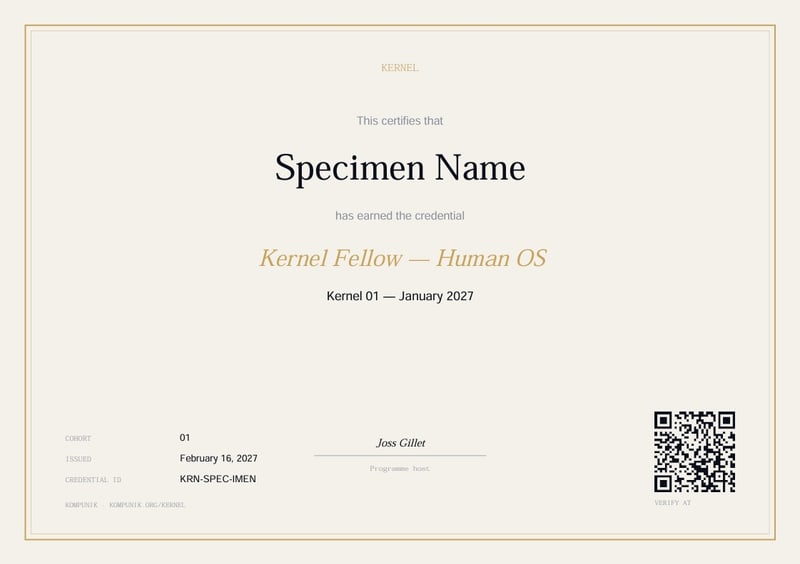
Attend three of four sessions, complete both questionnaires and the diagnostic, and submit a 90-day plan. Fellows receive a verifiable credential, a certificate, a one-click LinkedIn certification, and their name, title and organisation in the Human OS Index.
Registration opens for the next cohort soon
04 — Why Kernel exists
Policy on the future of work is being written now. Mostly without the people who run organisations.
Governments, international agencies and research bodies are deciding how to prepare workforces for AI. Most of their evidence comes from economists, surveys of workers and technology vendors. What's missing is the view from the people who run organisations: what you're actually seeing, deciding and worried about.
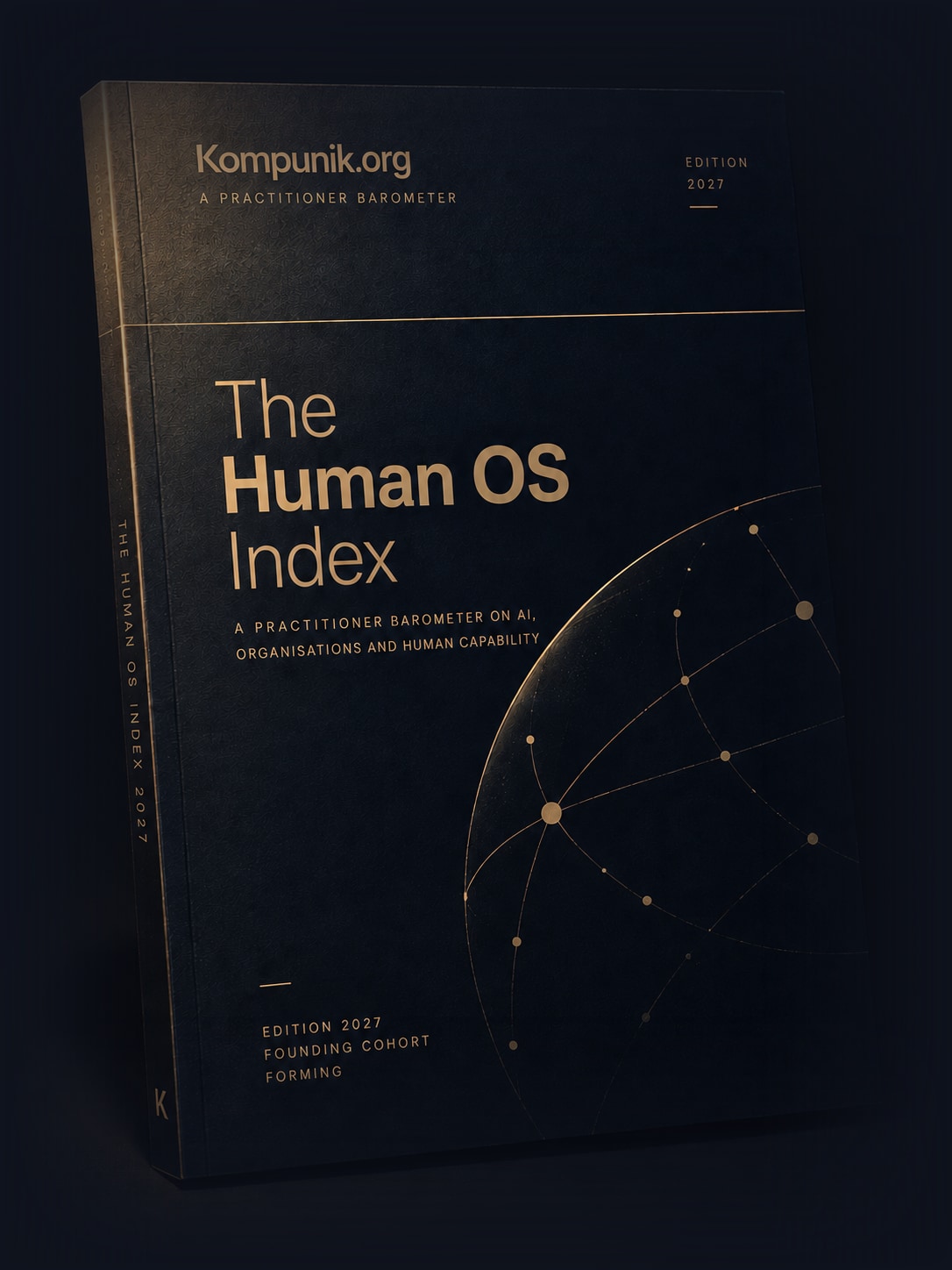
Every Kernel cohort answers the same core questions. At the end of each year, those answers become the Human OS Index, a practitioner barometer on AI, organisations and human capability. It is published openly and submitted to the institutions working on the future of work. Every leader who took part is named in it.
Contributor
Every participant who opts in. Named in the report.
Fellow
Named with title and organisation.
Practitioner voice
Selected Fellows. Quoted insight or case vignette in the report.
Editorial panel
Three to five alumni. Review the findings in a closed session before publication.
Submitted to
- International Labour Organization
- OECD
- European CommissionDG Employment
- World Economic Forum
- Ministère du TravailFrance
- and national labour ministries across Europe
The Human OS Index is an independent publication. Submission does not imply endorsement by any institution listed.
05 — Your host
Joss Gillet
Author · Industry research · Former CTO · Human OS
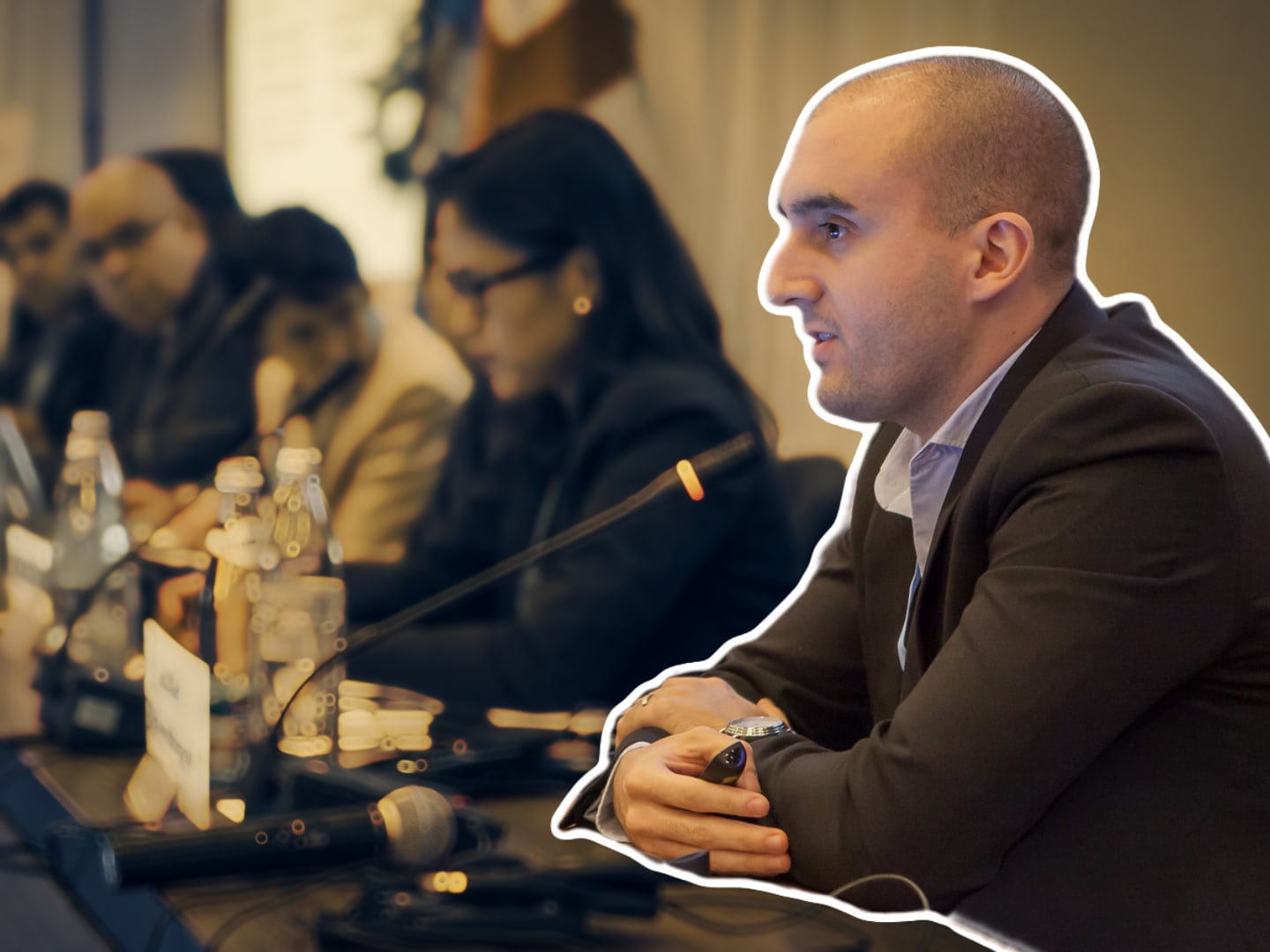
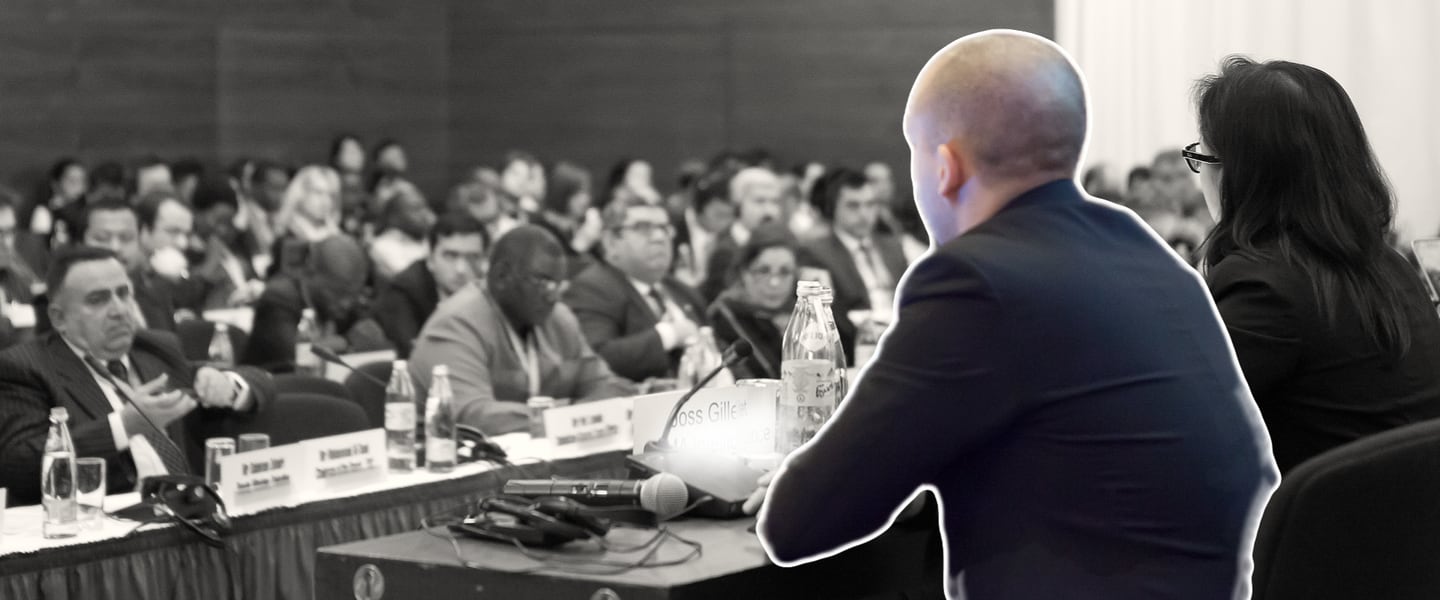
Joss has spent twenty years building and scaling teams across the UK, India and France, in telecom and in agriculture. He directed GSMA Intelligence's research team for a dozen years. He was CTO of Hiphen, a global agtech startup, for eight years.
Joss contributed many telco industry reports during his tenure at GSMA. He wrote Chapter 3 to the ITU's Measuring the Information Society Report 2018, the United Nations' annual global benchmark on the digital economy. He also wrote a well-received business book about AI. The Human OS Index applies the same discipline to a question the statistics don't yet cover: what the people running organisations actually see coming.
Human OS is the framework he developed for how people communicate, collaborate and grow inside organisations. Kernel is where he teaches it.
 The Customer Affinity Manifesto
Book · The Customer Affinity Manifesto · Reviewed on Reedsy Discovery
 Measuring the Information Society Report 2018
Report · ITU Measuring the Information Society 2018 · Chapter 3
06 — Who's in the room
Twenty-nine peers. Chosen by the question, not the sector.
Kernel is for people who make decisions about how organisations run: directors, executives, founders, HR and L&D leaders, and heads of transformation. Cohorts mix sectors and countries on purpose, because the most useful answer to your question often comes from someone in a different industry.
Founding cohort · January 2027 · Be among the first names in the Index
07 — How to take part
Three steps. Then the room opens.
- 01
Choose your cohort.
English or French. Cohorts run in cycles through the year.
- 02
Reserve your seat.
Individual or company. It takes about three minutes.
- 03
Meet your peers.
Your cohort space opens seven days before Session 1.
The Kernel calendar
5 cohorts left to contribute to Edition 2027
For leaders investing in themselves
€630excl. VAT
Includes
- 4 live sessions
- Private cohort space and direct line to Joss
- All six Kernel documents
- Kompunik All-Access for 12 months
- Fellow credential
- Named in the Human OS Index
- One peer nomination
For organisations
€1290excl. VAT
Everything in Individual, plus
- White-label Briefing Pack for your executive committee
- Your organisation benchmarked against the cohort
- 5 Kompunik seats for your team for 90 days
- Seat transferable to a colleague
- Invoice in your company's name, with PO number
- Attendance statement for HR
Know someone who should be in the room?
Every paid seat comes with one nomination. Invite a leader from another organisation at 50% of your seat price. They receive a personal invitation from you, join as your nominee, and you're credited as their sponsor on the roster, on your credential and in the Index.
How nominations work →08 — Questions
Before you reserve.
90 minutes live per week for four weeks, plus 1–2 hours of optional work between sessions.
Replays are available in the cohort space. Fellow status requires attending three of four sessions live.
Each cycle runs one cohort in English and one in French. The content is equivalent.
Yes. Choose the company seat. It includes the team pack, the invoice is issued in your company's name with its VAT number, and the seat is transferable. Individual invoices cannot be converted to company invoices afterwards. For scale: a consultant day in France runs to about €850. A company seat is four live sessions, six documents you keep, your organisation benchmarked against the cohort, five Kompunik seats for your team, and a named contribution to the Index.
Twelve months of the full Kompunik platform, included in every seat.
Answers are aggregated and pseudonymised. No individual response is ever published or shown to peers. Being named as a contributor is opt-in and separate from your answers.
Every paid seat includes one nomination for a leader from another organisation, at 50% of your seat price. They join as your nominee, and you're credited as their sponsor.
No. It is an independent publication submitted to them.
Full refund up to 14 days before Session 1, no reason needed. Between 14 and 7 days, transfer to a later cohort or a 50% refund. From 7 days — when your cohort space opens — a transfer is still available if you have not attended a session.
Kernel Fellow is a Kompunik credential, verifiable online. It is not an accredited academic qualification.
The 2027 Index will have a list of names at the back. Yours could be on it.
Registration opens for the next cohort soon
Not this cohort? Or not yet?
Tell us which cohorts interest you and we will write when their registration opens. You can pick more than one.